Hanoi's Old Quarter

Hang Ma Street
It is very likely that the first thing tourists do is traveling around Hanoi’s Old Quarter when they come to Vietnam. Hanoi’s Old Quarter has been well known for the history, the architecture and diversity of products.
Located between the Lake of the Restored Sword, the Long Bien Bridge, a former city rampart, and a citadel wall, the Old Quarter  consists  of 36 old streets inside.

Although the old section of Hanoi is often called the "36 Old Streets," there are more than 36 actual streets. Some researchers believe that the number 36 came from the 15thcentury when there might have been 36 guild locations, which were workshop areas, not streets. When streets were later developed, the guild names were applied to the streets.
Visitors will certainly be eager to wander along the old streets to drop by stores and buy specialties. Tourists would like to explore the Old Quarter, with some names of specialized streets: China bowls (Bat Su), roasted fish (Cha Ca), silver or jewelries (Hang Bac), women accessories (Cau Go), shoes and sandals (Hang Dau), silk (Hang Gai), mixed fruits (To Tich), combs (Hang Luoc), jars (Hang Chinh), tour services (Ma May), candies and dry apricot (Hang Duong), fried/roasted sour pork hash (Tam Thuong lane on Hang Bong Street), bamboo products (Hang Buom).
The Old Quarter still retained much of the original traits that interests tourists, especially those with architectural passion. These houses are neither tall buildings as people normally see in cities nor stilt houses on lines of poles, which were popular in Vietnams' mountainous regions these days. They are also called "tubular houses" which are short and narrow but have great length.

Hanoi’s ancient silk weaving village

Van Phuc Silk village
Located about 10 km from Hoan Kiem Lake, Van Phuc silk village still retains the original characteristics of an ancient village of Vietnam, with age old banyan trees, wells and communal house.

The village has been renowned for its traditional sericulture, weaving, and silk products. Tourists coming here are lured by various beautiful shirts, crafts, ties, dresses and many other items of silk available in the village. What is special is that the silk is made by very simple looms, which is the genuinely traditional Vietnamese way of making silk fabric.

For centuries, silk has been considered an extreme luxury, on par with rhinoceros horn, ivory and precious handworks in Vietnam. It has long been a universal byword of luxury, often worn by the richest, most powerful citizens. Most visitors somehow have heard about the significant role of this kind of material in Vietnam, yet might wonder where the cradle of Vietnamese silk lies. The mentioned Van Phuc Silk Village is proud to be the origin of best silk and silk-making industry of Vietnam, which is attached to a long-lasting history of more than two thousand years. Though enduring many ups and downs during that time, in recent years the village’s craft has enjoyed a revival due to a surging demand for silk in both the domestic and foreign markets.
Van Phuc


Today, the fine and lustrous cloth that originates from the cocoon of the silkworm is more affordable to "ordinary" folk. Furthermore, silk is currently enjoying a fashion renaissance, particularly since its many varieties can be made into a wide range of designs suitable for all facets of modern life. Should you intend to have a silk pair of formal clothes made, just come here and select the materials that suit you, and professional tailors will bring you satisfaction!

Like other visitors to the village, you will be surprised at this “silk shop town”, where almost all houses along the paths have been turned into shops selling silk products. The village is now home to 1,280 households, with 90% involved in silk production and business. More than 2 million meters of silk are produced here each year. Most importantly, coming here offers you a good chance to explore the Vietnamese traditional industry of silk-making.
Van Phuc village


No tourists here are left discontented when they glimpse the variety of glistening silk products. They are always confronted with an initially bewildering array of silk items, from raw materials to garments, and a myriad of silk accessories. The local silk is known for its smooth and lightweight appearance, and of qualities that enable it to be dyed more colors to suit a variety of skin tones. In order to cater to the changing demands and tastes of customers, Van Phuc silk producers are expanding their silk and garment repertoire: traditional glossy, embroidered silks, double layers, wrinkled silks, and of course, more colors, hues and weights, for which they have invented new techniques in dying and thermo-processing of the threads.

If you are going to buy something from Vietnam to bring back as a gift for those at home, all types of silk and clothes made of silk of your choice are available in the village. Though the days when Vietnam's silk was reserved for nobility are long past, what will never change is the sense of romance and luxury imparted by silk, a luminous type of cloth. With 2000 years of history behind them, the silk weavers of Van Phuc Silk village are still busy, weaving dreams.

Dong Mo tourist destination

Dong Mo Lake
Dong Mo resort, about nearly 40km to the west of Hanoi, is part of the Cultural and Tourism Village of ethnic Vietnamese groups and a starting point of the Tay Son-Ba Vi tourism complex.
The touristattraction also makes impression to tourist by its tourists resort anda standard golf.

Atthe foot of Ba Vi Mountain in Son Dong Commune, Son Tay Town, with a total area of 1,300ha, Dong Mo Resort is an ideal site for camping,Sunday picnics, or vacations. 
More than 20 islands emerge from the lake.There is an international 36-hole golf course in King Island. Prettyvillas partially hidden in the woods mirrored in the transparent waterof the lake. 
Kings' Island Golf
TheGolf Course is covered with velvety, verdant grass, and has 18 holes ofinternational standard. The club is located along the shores of Dong MoLake. Accessing to the course is by boat. 
Kings'Island is the first 36-hole facility in northern Vietnam, including anair-conditioned clubhouse and restaurant, driving range, pro-shop,putting greens and sand bunker. It also has a clubhouse, swimming pool,tennis courts, sauna, guest villas, and boat dock.
Many families select Dong Mo for their weekend relaxation as they enjoy fresh air, diverse entertainment services, and distinctive dishes of different regions.
With an abundance of green foliage, Phuong (Phoenix) Island is an ideal venue for children’s outdoor activities such as fishing, chicken hunting, and bamboo shoot collecting.

Van Phuc Silk Village

Van Phuc Silk
Most tourists visiting Hanoi would like to buy silk products as presents for their friends and relatives. Van Phuc village has been well known for various beautiful shirts, crafts, ties, dresses and many other things made of silk.
Ha Dong silk village is known as Van Phuc silk village, Van Phuc, Ha Dong, Ha noi. It is far about 10 kilometer from the center of Hanoi. This is the most famous silk village from ancient time; there are many patterns and long-stand of Vietnam.

Van Phuc silk is selected under the reign of the Nguyen. Located on the Nhue River, Van Phuc silk village retains many features ancient such as the well, lotus flower, tree… Van Phuc silk village has reputation with silk weaving tradition. 

For centuries, silk has always been considered an extreme luxury, on par with rhinoceros horn, ivory and precious handworks in Vietnam. It has long been a universal byword of luxury, often worn by the richest, most powerful citizens.
Van Phuc Silk

Most visitors somehow have heard about the significant role of this kind of material in Vietnam, yet might wonder where the cradle of Viet silk is. The mentioned Van Phuc Silk Village is proud to be the origin of best silk and silk-making industry of Vietnam, which is attached to a long-lasting history of more than two thousand years.
Though passing by lots of ups and downs, during the recent years, the village’s craft has enjoyed revival due to a surging demand for silk in both the domestic and foreign markets.
Though the days when Vietnam's silk was reserved for nobility are long gone, what would never change is the sense of romance and luxury imparted by silk, a luminous cloth type. With 2000 years of history behind them, the silk weavers of Van Phuc Silk village are still busy, weaving dreams.

Beautiful 300-year-old house in Duong Lam ancient village

Old House in Duong Lam
Duong Lam, in Son Tay town, Hanoi, Vietnam, is the first-recognized ancient village in Vietnam. The ancient village has a history of about 1,200 years with many houses dating back up to 400 years.

Two of Vietnam’s kings, Phung Hung (761-802) and Ngo Quyen (896-944) were born in Duong Lam, giving the village its prestige. Both men led resistance wars against northern invasion and after winning national independence, were crowned kings. After their deaths, the local people built temples in their honor.

Today, Duong lam village still retains most of the basic characteristics of a village of Vietnam with port village, trees, courtyard, temples, well, water fields… The roads of Duong lam were special because they have the shape as the bones of fish. Some features are still kept in Duong Lam ancient village is the old village gate in Mong Phu village.

Duong Lam has 956 traditional houses, Dong Sang has 441 houses, Mong Phu has 350 houses and Cam Thinh Has 165 houses. Many houses have been built a long time ago (in 1649, 1703, 1850…). Characteristics of the old traditional houses are all built from blocks of laterite. The trade village here is also famous and quality of the village is not inferior to the same village such as: Ban village, Cu Da…
Old House in Duong Lam 1

The communal house is a worshipping place of the god – founder of the village. The ancient village consists of 5 villages so it has 5 communal houses. Doai Giap and Cam Lam communal houses dedicate to Phung Hung – the national hero who won the victory against invaders under Duong Dynasty; Cam Thinh communal house dedicates both the founder of the village and great mandarin Cao Phuc Dien – the hero under Le Dynasty. Dong Sang communal house worshiped the God but it was destroyed by fire and was restored by financial support from people. The god Tan Vien Son was dedicated in Mong Phu communal house. So far, Mong Phu communal house is a gathering place of the villagers for cultural activities. The communal house was made carefully with sophisticated decoration details. It is considered as a flower of unique sculptural architecture.
Old House in Duong Lam 3

For a tangible culture relic, Duong Lam has 21 relic sites, consisting of temples, pagodas and tombs and ten of which have been classified as national and provincial relics. For an intangible cultural relic, Duong Lam has preserved various festivals, customs and literature on the people and land of Duong Lam through different period of time. For ecological environment, Duong Lam has many beautiful scenes linked with legendary stories such as Guom Hill, Ho Gam Hill and tales on the two kings Phuong Hung and Ngo Quyen.

Enjoying Vietnamese noodle soup in Ha Noi

Hanoi Noodle
"Phở" (noodle soup) is not only a popular dish in Ha Noi, but also a national dish of Viet Nam. As a culinary ambassador, it promotes the city's culture around the world.
Born in the early 20th century, the Vietnamese pho has been gone together with Vietnam ups and downs. Pho is not just simply a delicious dish but it really is becoming a "culinary ambassador" contributing honor Vietnamese culture to international friends. Pho is praised in all art forms: poetry, art, movies, theater. The dish is full of homeland’s aroma.
Since its first appearance in the country, phở has been accepted and favored by even the most discriminating of people. In the early days of the 20th century, phở was sold by street vendors who carried it to every corner of the city. At that time, there was only one kind of phở called "phở bò chín" (well-done beef soup), but people later created more kinds such as "phở bò tái (rare beef phở) and "phở gà (chicken phở). 
Hanoi Noodle 1

Pho is a Vietnamese noodle soup consisting of broth, linguine-shaped rice noodles called “banh pho”, a few herbs, and meat. Pho is a popular street food in Vietnam and the specialty of a number of restaurant chains around the world. It is primarily served with either beef or chicken.
According to chef Didier Corlou of Sofitel Metropole Hanoi, if you visit Viet Nam and don’t try phở, then you haven’t really experienced the country’s cuisine. “Phở is one of reasons I’ve remained in Viet Nam for fourteen years”, says Corlou, referring to the popular soup found on almost every street. Mr. Corlou is so impressive with Pho that he and other French advocates persuaded Ambassador Fre’de’ric Barono of the European Union to organize a workshop on the popular dish. “Pho”- Vietnamese Heritage attracted attention cultural researchers, poets, and Vietnamese culinary experts.
The millennial capital city is developing very fast with modern buildings, a modern lifestyle and the proliferation of foreign dishes. Ha Noi’s cuisine is also changing and there are many restaurants serving fast-food from western countries. People now can even enjoy their favorite phở in deluxe air-conditioned restaurants.
Hanoi Noodle 2

However, many Hanoians enjoy eating pho in a crowded restaurant where they have to wait a long time to be served because they think, if the restaurant is crowded, that means its phở is particularly delicious. It’s the taste that matters most.
Suggestion address:
- At 13 Hang Giay street, Hoan Kiem district, Hanoi city
- At 336B, Ba trieu street, Hoan Kiem district, Hanoi city 
- At 49 Bat Dan, Hoan Kiem district, Hanoi city
- At 13 Lo Duc street, Hai Ba Trung district, Hanoi city
- At 1 Hang Trong street, Hoan Kiem district, Hanoi city
- At 105-B12, Khuat Duy Tien street, Thanh Xuan district, Hanoi city

Hanoi honours ancient dream

Bach Ma Temple
We gathered in a slight drizzle outside Bach Ma Temple at nine in the morning. Our walking tour of the Old Quarter was about to begin.
We walked through a courtyard into an inner hall, at the temple in which was an elaborately adorned horse in faded white.

Bach Ma means white horse, our guide said, adding that it symbolised the one that, according to legend, Ly Thai To dreamt of after trying unsuccessfully to build the walls around Hanoi citadel.

The king ordered his workers to build the walls along the path the horse had chosen, and they stayed up.

As someone from a Christian background, I found it an odd custom to be worshipping a white horse, or the spirit of one. I am familiar enough with Buddhism, and the worship of Buddha. But a white horse?

This aspect of Vietnamese culture was highly intriguing. It is not just legendary spirits, actual historical figures are also worshipped, the guide said.

We were told that the script on one horizontally hung wooden panel read: Extremely miraculous temple of the White Horse. People pray to spirits resident in the temple for miracles to grace their lives, we were told.

Not much different from praying to St. Anthony for help in finding lost keys or money, or to Our Lady of Fatima for a medical cure, I thought. Amidst the differences in practices, there were similarities as well.

I also found it interesting that the building had been rebuilt several times. This has happened with many temples that were first built centuries ago in Vietnam.

In the West, people move heaven and earth to preserve such buildings, but here, people seemed to have no qualms about rebuilding a crumbling structure. No looking back.

To me, this spoke of gracious detachment, an acceptance that change is just the way of the world.

Mother Goddesses
Quan Chuong Gate


On one side of the inner hall, a guide showed us statues of three Mother Goddesses. The Vietnamese worship Mother Goddesses, of the Sky, Water and Forest. In the Catholic faith, it is fervently pointed out that Mother Mary is not a God.

I do not really know the origins of this belief, but the Church forbids the worship of Mary, though Christians do pray to her. In Vietnam, there appears to be no problem worshipping Mother Goddesses.

Among other things, it struck me that there was greater gender parity here, at least among the deities.

Our next stop was a temple rarely visited by tourists called Huong Nghia. It is dedicated to a military general who fought against the Chinese.

Again, though I found it odd at first to dedicate a temple to an actual person, I also realised that people of the Christian faith also pray to dead relatives, to intervene with God on their behalf.

A short block away was Quan Chuong, a city gate that amazed me. When Ly Thai To walled off the Hanoi citadel, he built 16 city gates along the perimeter. The only one that remains today stands on Quan Chuong (city gate) Street.
Old house in Ma May


I had been living here a year, but did not know of this gate. While the structure is not the original one built by the emperor, it still carries so much history. Even less known is the black tablet on one inner wall of the gate with inscriptions in Nom, the original Vietnamese script. Expecting it to mention great historic events or perhaps an imperial decree, I was pleasantly amused to learn that its likely meaning is, "funeral processions should not be taxed when passing through the gates" – a very pragmatic announcement.

Further north, the Huyen Thien Temple on Hang Khoai Street is especially unique in being a chua (Buddhist pagoda), a den (Taoist temple) and a dinh (community hall) at the same time. Such a combination would be inconceivable in Western society.

There were two other stops on our tour – a traditional house on number 87 Ma May and a jewelry communal house on 42 Hang Bac, each with its own attractions and stories.

The tour showed me the value of getting rid of any ethnocentrism that we might carry within us. This can make the world a more wonderful place. 

Source: Victoria Fritzby/ Hanoitimes

Hoa Lo Prison

Hoa Lo Prison
Hoa Lo is a prison in the central of Hanoi Capital. This place is named to the street of Hanoi under the French colonial, due to the concentration of stores selling wood stoves and coal-fire stoves along the street from pre-colonial times.
The prison was built in 1896 by French colonial to detain prisoners and political crimes. Today Hoa Lo just left a small corner where guests come to visit. Hoa Lo is also in the top 10 list of the most notorious prisons in the world.

Following the defeat at the battle of Dien Bien Phu and the 1954 Geneva Accords the French left Hanoi and the prison came under the authority of the Democratic Republic of Vietnam. Thereafter the prison served as an education center for revolutionary doctrine and activity, and it was kept around after the French left to mark its historical significance to the North Vietnamese.
In 1993, on the ground of Hoa Lo Tower of Hanoi, a commercial center was built; the rest becomes a historic relic of capital revolution, which is evidence of the crimes of French colonial. It also kept many documents and records of the indomitable example, fought and sacrificed heroically of many generations of arrested communists. Hoa Lo relic is a fascinating attraction attracting many domestic and foreign tourists on every their occasion in Hanoi.
Hoa Lo is also a prison where retained a lot of great communists of Vietnam, addressing at 1 Hoa Lo street, Hoan Kiem district, Hanoi.

Madonna lily in Hanoi

Madona Lily
Madonna lily is a kind of flower which blooms in April. In Vietnam, it is called “Hoa loa ken”, which means gramophone. It’s because of this flower’s shape. Owning a subtle beauty, this flower was widely used to decorate the houses of middle class families in the past. They believed that the pureness and exalted appearance of this flower reflects their style and personality.

“Hoa loa ken” also reminds us an image of a virgin in white Ao dai. It became the symbol of this flower since the painting was widely known “Young Girl by Lilies” by a famous artist To Ngoc Van.Nowadays, people could glimpse bicycle filled of white Madonna lilies on streets such as Phan Dinh Phung, Tran Phu, Xuan Dieu. It’s the icon of the month April, and of Hanoi that you will never forget.

Hanoi throughout history

Hanoi City in the past
Hanoi, Vietnam's capital, lies on the banks of the Red River, some 100 kilometres from its mouth. Human settlements at the place date back as far as the 3rd century B.C.

In 1010 Hanoi, at that time known by the name of Thang Long, became capital of the first Vietnamese dynasty independent from the Chinese. The city received its present name, Hanoi, only in 1831. However, at that time not Hanoi but Hué was the capital of the Vietnamese empire.

In 1882 Hanoi was conquered by a French expedition. In 1883 France forced the then uncolonialized North of the Vietnamese empire to accept the status of a French protectorate. The French administratively divided the country into the colony Cochin China (in the South) and the protectorates Annam (central Vietnam) and Tonkin (North Vietnam). Hanoi became the capital of the protectorate Tonkin.
Ho Chi Minh Mausolium

Vast parts of present-day Hanoi were built during the French colonial occupation. With its broad boulevards and a French-inspired architecture the city has a noticeable structural charm.

The French abandoned Hanoi after their defeat at Dien Bien Phu and the division of Vietnam into two separate states according to the Geneva Treaty signed on July 20, 1954. Ho Chi Minh made Hanoi the capital of North Vietnam and initially concentrated on the expansion of the city's industry.

During the US bombardments of North Vietnam from March 1965 to October 1968 the authorities evacuated 75 % of Hanoi's population. After the end of the bombardments the city again grew rapidly. Today the population of Hanoi counts more than 3 million.

Nevertheless, the city does not seem as crowded as Ho Chi Minh City, the former Saigon. And even though Hanoi is the political capital of the country, Ho Chi Minh City definitely is ahead economically.

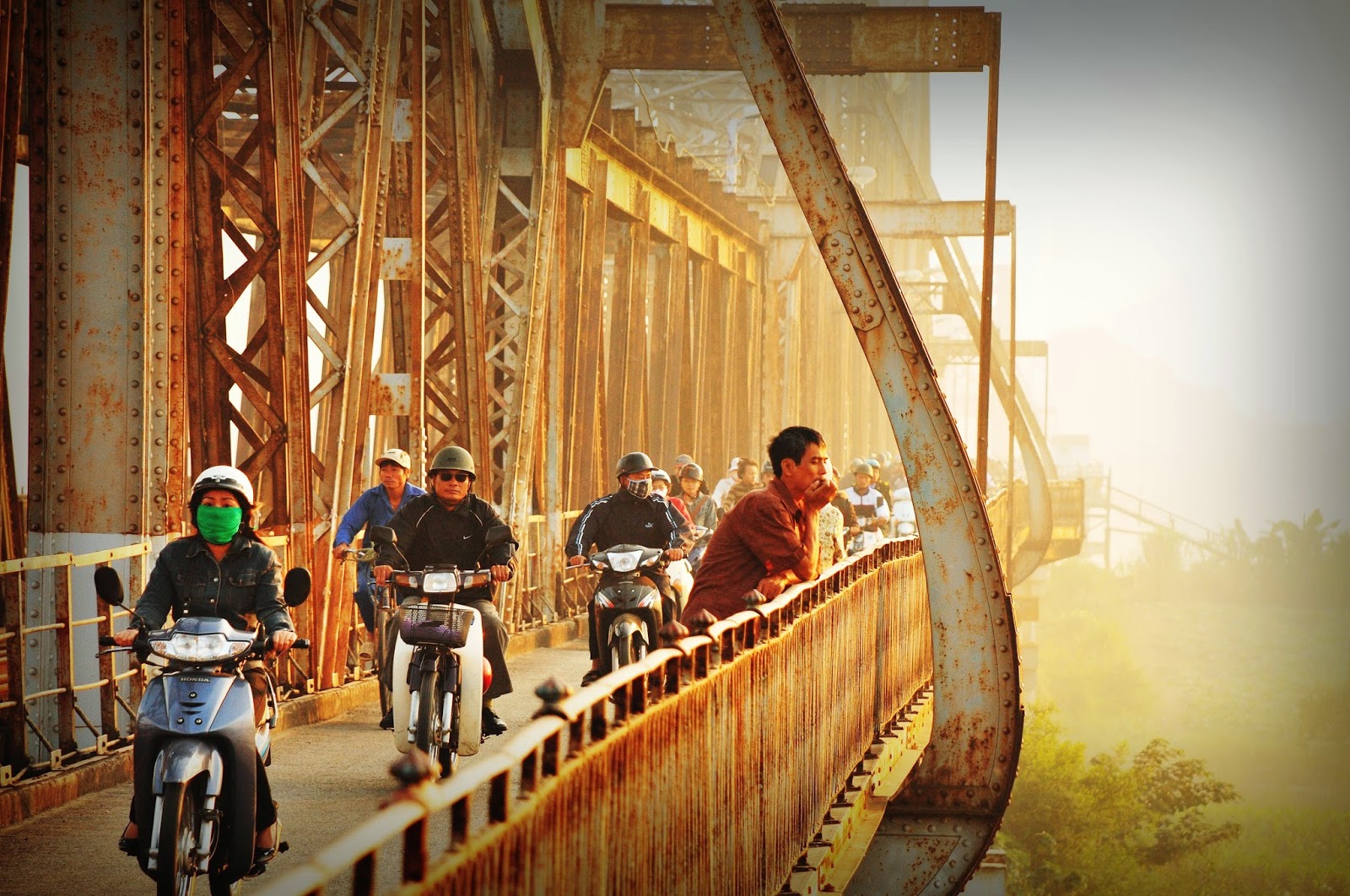
Long Bien bridge: Heritage in the heart of Hanoians

Long Bien Bridge
For generations of Hanoians, the iconic Long Bien Bridge spanning the Red River has become synonymous with their everyday life.

Le Van Minh, 62, who has lived near Long Bien Bridge for years, says he will never forget his childhood when he and his friends used to pass the bridge to go out to Gia Lam District.

"It was back in 1962 when I was just 10 years old. We passed the bridge and went down to the rich alluvial ground of the Hong (Red) River to go fishing and get maize," he recalls.

"After walking along for just several minutes, we felt as if we were living in a world of peace, tranquillity and fresh air. That’s why I still visit the bridge with my grandchildren every day."

Like Minh, many Hanoians living near the bridge say their lives are intrinsically linked to the image of the steel structure that was erected more than 100 years ago.

"We have seen the bridge since we were born and, we have travelled along it our entire lives," says Nguyen Van Thang, a local resident. "For us, it has become heritage in our minds."

Whenever you visit the bridge, you can see crowds of young people taking photos for souvenirs or wedding albums. Foreign visitors like to stroll along the bridge to enjoy the fresh air, and catch a panoramic view of the city.

Recently, the Ministry of Transport proposed three options to modify and modernise this iconic and historic bridge.
Long Bien Bridge


The ministry said the rationale behind the plan is to accommodate the rapidly increasing volume of traffic between the districts of Hoan Kiem and Long Bien, situated on either side of the Red River.

The first option is to build a new bridge exactly where the old one stands, keeping the central part with the railway track intact, and moving other sections of the bridge elsewhere for preservation.

The second option is to construct a new, modern bridge of similar design.

The third choice is to modernise the bridge while retaining its central section and the trusses.

The 116-year-old bridge spans three centuries and is considered an important and central part of  Hanoi’s  development and history.

The steel structure witnessed the withdrawal of French troops from Hanoi and welcomed Vietnamese soldiers to liberate the capital in 1954. It was also severely damaged by fierce American bombardments during wartime.

Professor and Architect Nguyen Viet Chau, Editor-in-chief of Architecture Magazine, notes the bridge has contributed significantly to the economic development of not only Hanoi but also other Red River Delta provinces namely Haiphong, Hai Duong, and Hung Yen.

The Hanoi – Haiphong rail route running through Long Bien Bridge enables cargo from Haiphong to be distributed to localities nationwide.
Long Bien bridge 1


Long Bien Bridge was designed by world renowned engineer Gustave Eiffel, who was also the designer of the famous Eiffel Tower in Paris. It was constructed between 1899 and 1902 and first opened to traffic in 1903. At the time it was then the only bridge spanning the Red River connecting Hanoi and Haiphong port city.

"We affirm that, till now, there are no other bridges in Vietnam that have the same history and unique beauty as that of Long Bien," says architect Pham Thanh Tung, from the Vietnam Architects Association.

"Given Hanoi’s rich history and culture, this bridge has huge cultural heritage attached to it that must be respected in line with the Heritage Law," he added.

Historian Professor Le Van Lan says the Long Bien Bridge, along with Mot Cot (One-Pillar) Pagoda and Ho Guom (Returned Sword Lake) represent the cultural and historical significance of Hanoi.

"Only when the bridge was built and put into use, did Hanoi have the opportunity to develop its urban areas on both river banks and form the important economic triangle of Hanoi-Haiphong–Quang Ninh, that exists today," said Lan.

At a Government meeting on February 28, Prime Minister Nguyen Tan Dung made the crucial decision to preserve the bridge to its original structure and asked the Ministry of Transport and Hanoi to design another railway bridge spanning the Red River to meet the increasing travel demands of local people.

This is excellent news for Hanoians who want to preserve the bridge as part of their emotional and spiritual life.


Vov/Hanoitimes